Call Our Grill Experts
+1 (866) 850-3450

Every method below produces a safe, finished turkey at the same internal temperature: 165F in the thickest part of the breast and the thickest part of the thigh, without touching bone. That number is the only one that is not negotiable. Everything else is a trade between time, oven space, skin, and how much attention you want to pay.
Pick by what you are short of.
Roast at 325F. Budget roughly 15 minutes per pound unstuffed, and start checking the temperature well before you think you need to.
This is the method that works, produces the drippings your gravy depends on, and occupies your oven for most of the day. That last part is the real cost. If the oven is also cooking everything else, something has to move outside.
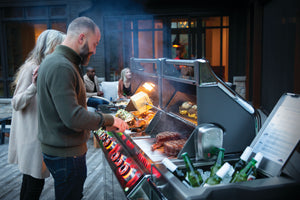
A covered gas or charcoal grill roasts a turkey perfectly well. Set it up for indirect heat, meaning the burners under the bird are off and the burners around it are on, and hold around 325F with the lid closed.
Two things to get right. Use a drip pan under the bird, both to keep the drippings and to stop flare-ups. And resist opening the lid: on a grill, every look costs you far more recovery time than it does on an oven.
Add a couple of wood chunks if you want a light smoke character without committing to a smoker.
Smoking gives the deepest flavor and takes the longest. Run hotter than you would for brisket. Poultry skin turns to rubber at low temperatures and the meat spends too long warming up, so 275F to 325F is the useful range for a whole turkey rather than the 225F you might use for pork.
Applewood and cherry are mild and suit poultry. Hickory is stronger and will dominate if you overdo it. Mesquite on a turkey is usually a mistake.
A fried turkey cooks in roughly three to four minutes per pound and produces skin nothing else matches. It is also the method that sets houses on fire, so the rules are not optional.
Cut out the backbone and press the bird flat, and it cooks substantially faster and far more evenly, because the breast and the thighs finally sit at similar heights. You lose the whole-bird presentation and you gain crisp skin across the entire surface.
This works in the oven, on the grill, and on a large griddle. It is the single best technique on this list for anyone who has repeatedly served dry breast meat next to underdone thighs.
The spit turns, the bird bastes itself, the skin browns evenly, and you do almost nothing. If your grill takes a rotisserie kit, a turkey is the best possible argument for owning one.
The limit is weight. Rotisserie motors are rated, and a large turkey plus the spit assembly can exceed that rating. Check your motor's figure before you plan the meal around it.
Buy a probe thermometer and use it. Almost every disappointing turkey is a timing estimate that went unchecked, not a method that failed.
If you are choosing equipment rather than a technique, our grills and smokers are worth a look, or call us on 1 (866) 850-3450 and describe the meal you are trying to cook.
{"one"=>"Select 2 or 3 items to compare", "other"=>"{{ count }} of 3 items selected"}
placeholder